Thursday, 17 December 2015

Storyboard


Fade In
EXT.Castle Grounds- Day
Natural Lighting
Presents a couple holding hands. Low Angle 
Dialogue: "We never used to be so happy.It used to be difficult. It's so much easier now." 


Seamless Editing to give re-wind effect
Ends with an establishing shot of Landau Forte Academy. With the time span gliding over the top. The sequence will be accompanied by upbeat and appropriate music.
Fade to black.

INT. College Restaurant- Day
Natural Lighting 
 Cuts to P.O.V of Mattie on his phone, shows him engulfed in his phone, ignoring his surroundings.

Artificial Lighting- from phone.
Cuts to a P.O.V/ Close up of Mattie's phone to present the messages.
Natural Lighting
The phone is snatched out of Mattie's hand and the messages are read aloud and comments are passed around.
Mattie makes attempts to get the phone back in a panicked manner.
He receives it back when all the messages have been read.

EXT. Outside of the college.
 Mattie exits the college once he received his phone.

EXT. Castle Grounds.
Over-voice as the scene fades to black.

Wednesday, 9 December 2015

BFI Statistical yearbook 2014


BFI Statistical yearbook 2014


The table above presents the information about the genres that were released during 2013. The two films that I’m focusing on are the genres, Horror and Thriller. The horror genre had 37 releases which is about half of the 64 that were released as thrillers. However, the horror genre is more successful this is due to the gross box office that the horror genre created, this is £57.5 million, whereas the thriller genre created a gross box office of £29.1 million. This is a £28.4 million gross box office difference, this alone identifies the success of the horror genre and it shows Hollywood and studios where the money is being made out of the two. The most successful movie from the horror genre was World War Z, this could be because he has a A-list film star, Brad Pitt. Whereas the film that is representative of Thriller which is 'Prisoners' who's lead is Jake Gyllenhaal, who is also a large star however, it can be argued that he isn't as popular as Brad Pitt and this has had the effect on gross box office.
The other genre that is shown within this table, that is important to the film that I will participate in making is Romance, this is a genre that had 34 films made in this style the genre had a gross box office of £13.9 this although not as successful as the thriller or horror it is still successful, the film that is used to represent it is 'I Give It a Year' where the lead role is Rose Byrne who isn't as popular and known as Brad Pitt.


The table shows the number of films released with 2013. It shows us that the most popular film to be released was Sci-fi,with 422 sites at the widest point of release. The horror genre had 145 sites at the widest point of release, this shows that although it wasn't shown in as many places as Sci-fi it was still highly successful because the places it was shown the target audience lived around, for instance the films would be shown in cinemas that had older residents, this is because most of the residents would be able to watch the movie and therefore the site and the genre in that area will be successful and would be able to have the maximum amount box office sales as possible. The thriller genre was shown in 89 sites at the widest point of release, this is although significantly lower then horror it is still shown in areas where the film will get the most views and would catch the attention of the local residents, meaning that they will get the maximum amount of views and ticket sales as possible. For instance the area it may have a C1 or C2 demographic. 
The romance genre, is only slightly lower then the thriller genre, however is still successful in its own way, this is because with only 34 releases in that genre they were when in 59 sites at the widest point of release, this would suggest that similar to the thriller and horror genre, the genre was released in the point of intrigues across the country where the demographic consists of C1 and C2 social classification as it would allow the film to develop a greater box office sales.


The graph above presents the proportion of box office that each genre got. It shows us that the most successful genres are action,animation, biopic and comedy. The horror genre is particularly low in box office proportions, with the most successful being the UK horror films with 5.8% however the lowest being UK independent films with 0.3%. It also shows that the thriller genre isn't doing too well either with the most successful in that genre being the UK independent films that are produced with 2.7% with the lowest being 1.6% with the thriller films produced by UK films, this is a small gap and it suggests that this genre wasn't very successful in box office proportions. 
The romance genre was more successful then the thriller genre overall as it's most popular films were created as UK independent films with 8.1% of box office proportions.


The second graph presents to us the figure 4.2 proportion of releases by genre for all films, UK films and UK independent films in 2013. It shows to us that 5.3% of the films released in 2013,were horror films made in Hollywood and then only 4.9% were made as UK independent films. The graph also shows that 12. 2%of the films released were of the thriller genre and were created by UK film makers. The graph portrays that 9.2% of films were thriller movies made by Hollywood producers.
The romance genre was successful in the view of its proportions as it is 4.9% of the amount of films made, this percentage was for Hollywood producers only. The genre also earned 2.2% of the proportions of films, this was for UK producers only.


Saturday, 28 November 2015

Stereotypical representation of Horror/ Thriller characters

The representation of characters in genres have been pre-established, which means that the stereotype of the types of characters have already been established to both the audience and the studio itself. This makes it easier for both the audience and the studio to develop and portray the type of character that takes effect on the narrative.

Horror Antagonist 
A famous horror antagonist that has been the most widely recognized character in films. He's remained to have the same stereotypical characteristics throughout the years since 1931, this antagonist is Dracula. He continued to have the same values, such as his age which is typically a middle-aged man who is White/Caucasian with an Eastern European accent, who speaks in broken English. He is visually represented with a black cloak and fangs and he lives on a mountain in a castle, the character can turn into a bat as he pleases. The representation of this character and his life follows the typical codes and conventions of the horror genre. The representation of a horror antagonist is typically a White middle ages male. Other famous horror antagonists are Hannibal Lecter, who is a cannibalistic serial killer.

Horror Heroines 

Horror heroines are rare, however they do happen. The typical representation of  heroines in the horror genre is a young, White females who are single and virgins. This representation as chanced throughout time. Heroines have now become very resilience, more violent and defensive. This is represented through characters such as Lara Croft ( Tomb Raider) who is although represented in a sexual manner she is also represented in a way that makes her come across as dominant without even watching her in action, this is portrayed through the use of guns and her costume which makes the audience believe she's confident and is dangerous. The use of the gun and costume also portrays that she is intelligent and can look after herself and doesn't need a man to protect her, this challenges the typical stereotype of the heroine. However the character meets stereotypical conventions as she is a White female who is in her early twenties. Another example would be Clarice Starling (The Silence Of The Lambs) who is a middle aged women who is White and is portrayed as an innocent detective, who is also determined and has a lot of resilience.


The representation of ethnicity in the Thriller Genre
Cultural Bias- There is such a things as 'White' centric in Hollywood which means that leading Actors and Directors have always been male Caucasian, whereas actors that play minor characters are played by black and ethnic minorities. Actors such as Will Smith and Morgan Freeman have broken this mold as they star in very successful movies and play big roles. These role of Robert Neville presents Will Smith  as intelligent and physically dominant in every sense of his nature. This is the result of the 1990's when things started to changed as in the movie Se7en when Morgan Freeman plays the smart, intellectual, senior, methodical detective. This challenges the stereotype and stigma around ethnicity in Thriller genre.

The representation of gender in the Thriller Genre 
Gender bias- Females have predominantly played the victim role, or the femme fatale (a seductive woman who can not be trusted). Since 1990 the representation of women in movies have been challenged and this is due to the film 'Silence of the Lambs' as the character 'Clarice Starling' is presented as a intelligent and strong woman who can solve her own problems and fight for herself. Her appearance presents her as threatening but not in a physical but in a intellectual way.This is presented through her posture and her costume as it makes her come across as a working class FBI rookie. Another portrayal of gender being challenged is Tomb Raider with her physically dominating presentation.

The representation of sexuality in the Thriller Genre

Heterosexual bias- Seeing a homosexual or lesbian protagonists is almost entirely rare even in Liberal Hollywood. The presentation of a leading male detective being openly gay is rare and unheard of. The movie 'The Rules of Attraction' is a film that portrays a male who is keeping him being bisexual a secret, until he comes out to one of his closest friends and is humiliated. It creates the negative stigma around being openly gay, The presentation of Paul Denton (left) played by Ian Somerholder is hidden away however aspects of how he reals wants to be becomes apparent. Although this is not a thriller movie, comparing the representation of Paul Denton to Hannibal Lecter.
Both characters keep their identities of having aspects of homosexual tendencies secret. The portrayal of Hannibal Lecter is similar to that of Paul Denton as he is originally presented as being fully heterosexual but we later discover otherwise. The representation of Hannibal, although in a more creepy and eerie atmosphere, the characters are represented  in the same mysterious narrative about their sexuality that is commonly hinted at. It proves that even in other genres including thriller character's either the protagonist or the antagonist, it is difficult for them to be openly homosexual due to the stigma and controversy around the subject even in modern society, also it is becoming a more popular idea and concept in modern movies.

Friday, 27 November 2015

Christian Metz- Model Of Genre Development


The Christian Metz model (1974) presents the exploration of the development of genre and suggested that genres pass through four phases:

1. The Experimental

 The Experimental phase is where early films are exploring and experimenting with the horror genre and other genres in the film's narratives. Examples of this phase consists of The Cabinet of Dr Caligari (1919) The film soon developed into what is now known as Jekyll and Hyde, the film experiments with the horror genre in its narrative. The narrative of Jekyll and Hyde is that Dr. Jekyll has a split personality and the bad side of this is Hyde who when not controlled he torments innocent citizens. Another example of this is Nosferatu (1922) which creates some of the similarities between Nosferatu and Dracula. Dracula now being the most widely recognisable horror character and still is with its fundamental stereotypical features that are displayed in horror films still to this day. The experimental phases made films help formalise the conventions of the horror film in its earliest phase.


2.The Classic
 The Classic is the phase of films which established the narrative conventions of the horror genre in its most successful and defining period. Hollywood films such as Dracula (1931) and Frankenstein (1931) made by Universal in colour it was a a huge success with the development of $12,000,000 in box office. The defining reason for this movie becoming a success is that it was in colour, which was a huge development at the time. The movie contained extreme horror conventions at the time such as the development of a man using different people's body parts, it creates the uncomfortable environment that the studio want to create for the audience.The studio then became know for horror with their publishing of Frankenstein and Dracula the most popular horror with that contained the most fundamental conventions for horror. Throughout media the development of classic phase is present as thing such as Michael Jackson's Thriller album cover with the walking dead being present, it gives the audience an uncomfortable environment. The Classic phase establishes the growth of the horror genre and it is typically more creepy and uncomfortable as we would find the Michael Jackson album cover more uneasy, this is the same with the Jekyll and Hyde cover that is shown above both are equally uneasy.

3.The Parody
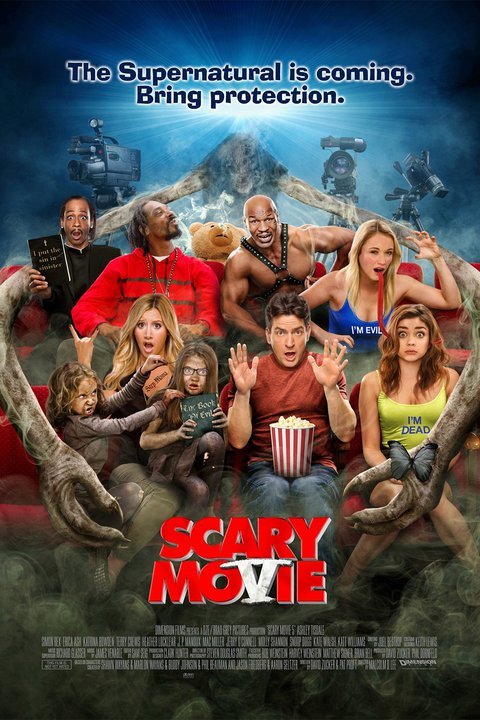
 The Parody phase is where films mimic the horror genre in a comical way, which eliminates the horror codes and conventions and would have typically have been there. Films such as Scary Movie (2000) which are very successful horror parodies that have continued for 13 years as the latest one (Scary Movie 5) has recently been released in 2013 and another (Scary Movie 6) is due to be released in 2016. The film has aspects of the codes and conventions of horror films such as jump-scares and they typically have the aspects of smoke and low- key lighting, however the film then continues to make a light hearted joke about the uneasy codes and conventions. Another film that creates the humorous aspects of horror films is the film 'Carry On Screaming'(1966) which presents a family that, aren't all that normal and a detective that is sent into the woods and disappears and is not seen again.The film makes multiple jokes about this in the way that similarly to the Scary Movie characters are to make comments that are seen as humorous due to their unexpected nature as there are large forms of danger that surrounds them.


4. The Deconstruction
 The Deconstruction phase is that the films which have taken the generic elements of the horror genre and amalgamated them into varying sub genres. Films such as Se7en (1995) and The Sixth Sense (1999) which both explore different types of genres in the within their narratives, for example Se7en involves elements of Film noir and the thriller genre into its story-line and editing. The Film noir element becomes apparent through its use of detectives in it's narrative. It also creates this aspect through the use of its low-key lighting which creates the same mysterious effect that it does in Film noirs. The thriller elements that are presented in the film Se7en is due to its story-line of the protagonist going after the antagonist in order to build tension and create a climax for the audience. The movie develops these codes and conventions to create a greater effect to work well with the codes and conventions of the horror genre that the movie also involves and uses effectively to create tension and keep the audience interested in the movie. The deconstruction overall involves taking aspects away from the core genre and adding aspects of other genres into the narrative and editing of the film.

Monday, 23 November 2015

MR JUDGE FEEDBACK

Hi Becky,

Please make your images bigger and more noticeable. Good work on Chinatown.


1.   STEREOTYPICAL REPRESENTATIONS OF THRILLER/HORROR GENRES/CHARACTERS

2.   TEXTUAL ANALYSIS OF OPENING OF A HORROR FILM – WOMEN IN BLACK/SCREAM etc.

Friday, 20 November 2015

Task 1 - Film Noir- Codes and Conventions

The term 'Film Noir' was created by Nino Frank, who was an Italian-born French film critic in 1946, the term itself means 'Black Film'. 


Film Noirs all have codes and conventions that are seen in almost all films in this genre. The most common convention that film noirs use is the narrative of the spider and fly. The spider and fly narrative is when the woman of the film draws the typically male detective in so that when the detective finds out she is part of the crime it is hard for him to do what he has to do for his job. An example of this although the film is a neo-noir, the spider and fly narrative still applies, is the film Chinatown (1974) the story-line is as follows "When Los Angeles private eye J.J. "Jake" Gittes (Jack Nicholson) is hired by Evelyn Mulwray to investigate her husband's activities, he believes it's a routine infidelity case. Jake's investigation soon becomes anything but routine when he meets the real Mrs. Mulwray (Faye Dunaway) and realizes he was hired by an imposter. Mr. Mulwray's sudden death sets Gittes on a tangled trail of corruption, deceit and sinister family secrets as Evelyn's father (John Huston) becomes a suspect in the case." -Google(Roger Ebert) There is typically an unspoken romance between the detective and the woman. The effect that this has on the audience is that they struggle to admit that she is the criminal, because of the romance between the detective and the woman. On the other hand the audience can also be effected in the way that they dread when the two characters create this unspoken romance, because they know that the woman will cause trouble and that the detective will have to turn her in so that he does his job. 


Another element of the effective use of lighting that they use within film noirs, the use of lighting to create the shadowing effect that most film noirs take advantage of.The low-key lighting creates the effect of mystery and helps build tension within the film. The effect that this has on the audience is that it makes the audience become intrigued as they want to know what is 'lurking in the shadows' it makes the audience continue watching the film, this is how the level of success is rated on films. The use of the lighting is also used to disguised the studio in the background. This was done because the small studios which were used to film the film noirs in would be shown in the film itself and would take away the separate universe that is created. These films were classed into B-list films, which would be shown in cinemas due to block booking. Block booking is where the cinema would buy A-list movies in 'blocks' of movies, this means that the B-list films that would be contained in the blocks would get profit from their movies being shown. The lighting in film noirs is described as "A feeling through a visual of low key lighting and story conventions". This supports the idea of the low key lighting being important to the story of the movie, it helps the studio get the message of mystery across to the audience. 

The iconography that is used in film noirs help create the moods of guilt and melancholy within the film.Iconography such as guns,cigarettes,trilby and overcoats. The iconography helps the audience identify the genre of the film. These types of iconography helps the studio present the atmosphere and emotions come across to the audience more clearly and helps the studio create what appeals the fans of that genre.The small details of things such as the trilby and and overcoat makes the movie come to life, it helps the audience fulfill their aim of watching movies which is to escape reality.The effects that the small details also make is that it makes people want to continue watching the movie,this is because they see the quality of the movie and are interested to see what happens as the small details portray the thought that it is a thought out movie that could have a strong and interesting story-line that they may not want to miss out on finding out about.  

Another convention that the genre uses effectively is the use of sound. The non- diegetic sound is a big aspect of film noir as they are typically created with background music throughout the film itself and not just the title or credits of a film. The music is typically created with strings and trumpets and normally creates a calming influence on the audience until something happens within the film and the music will become tense to help create the emotions that the film is trying to create for the audience to experience. The effect that this has is that it makes the film effective and makes the audience experience multiple feelings and helps them see different point of views from within the film. It helps them become engulfed in the film and helps the film fulfill the aim of making the audience feel what the characters feels as most of the time the story is told through the detectives point of view and the audience only knows as much as the detective.