Saturday, 28 November 2015

Stereotypical representation of Horror/ Thriller characters

The representation of characters in genres have been pre-established, which means that the stereotype of the types of characters have already been established to both the audience and the studio itself. This makes it easier for both the audience and the studio to develop and portray the type of character that takes effect on the narrative.

Horror Antagonist 
A famous horror antagonist that has been the most widely recognized character in films. He's remained to have the same stereotypical characteristics throughout the years since 1931, this antagonist is Dracula. He continued to have the same values, such as his age which is typically a middle-aged man who is White/Caucasian with an Eastern European accent, who speaks in broken English. He is visually represented with a black cloak and fangs and he lives on a mountain in a castle, the character can turn into a bat as he pleases. The representation of this character and his life follows the typical codes and conventions of the horror genre. The representation of a horror antagonist is typically a White middle ages male. Other famous horror antagonists are Hannibal Lecter, who is a cannibalistic serial killer.

Horror Heroines 

Horror heroines are rare, however they do happen. The typical representation of  heroines in the horror genre is a young, White females who are single and virgins. This representation as chanced throughout time. Heroines have now become very resilience, more violent and defensive. This is represented through characters such as Lara Croft ( Tomb Raider) who is although represented in a sexual manner she is also represented in a way that makes her come across as dominant without even watching her in action, this is portrayed through the use of guns and her costume which makes the audience believe she's confident and is dangerous. The use of the gun and costume also portrays that she is intelligent and can look after herself and doesn't need a man to protect her, this challenges the typical stereotype of the heroine. However the character meets stereotypical conventions as she is a White female who is in her early twenties. Another example would be Clarice Starling (The Silence Of The Lambs) who is a middle aged women who is White and is portrayed as an innocent detective, who is also determined and has a lot of resilience.


The representation of ethnicity in the Thriller Genre
Cultural Bias- There is such a things as 'White' centric in Hollywood which means that leading Actors and Directors have always been male Caucasian, whereas actors that play minor characters are played by black and ethnic minorities. Actors such as Will Smith and Morgan Freeman have broken this mold as they star in very successful movies and play big roles. These role of Robert Neville presents Will Smith  as intelligent and physically dominant in every sense of his nature. This is the result of the 1990's when things started to changed as in the movie Se7en when Morgan Freeman plays the smart, intellectual, senior, methodical detective. This challenges the stereotype and stigma around ethnicity in Thriller genre.

The representation of gender in the Thriller Genre 
Gender bias- Females have predominantly played the victim role, or the femme fatale (a seductive woman who can not be trusted). Since 1990 the representation of women in movies have been challenged and this is due to the film 'Silence of the Lambs' as the character 'Clarice Starling' is presented as a intelligent and strong woman who can solve her own problems and fight for herself. Her appearance presents her as threatening but not in a physical but in a intellectual way.This is presented through her posture and her costume as it makes her come across as a working class FBI rookie. Another portrayal of gender being challenged is Tomb Raider with her physically dominating presentation.

The representation of sexuality in the Thriller Genre

Heterosexual bias- Seeing a homosexual or lesbian protagonists is almost entirely rare even in Liberal Hollywood. The presentation of a leading male detective being openly gay is rare and unheard of. The movie 'The Rules of Attraction' is a film that portrays a male who is keeping him being bisexual a secret, until he comes out to one of his closest friends and is humiliated. It creates the negative stigma around being openly gay, The presentation of Paul Denton (left) played by Ian Somerholder is hidden away however aspects of how he reals wants to be becomes apparent. Although this is not a thriller movie, comparing the representation of Paul Denton to Hannibal Lecter.
Both characters keep their identities of having aspects of homosexual tendencies secret. The portrayal of Hannibal Lecter is similar to that of Paul Denton as he is originally presented as being fully heterosexual but we later discover otherwise. The representation of Hannibal, although in a more creepy and eerie atmosphere, the characters are represented  in the same mysterious narrative about their sexuality that is commonly hinted at. It proves that even in other genres including thriller character's either the protagonist or the antagonist, it is difficult for them to be openly homosexual due to the stigma and controversy around the subject even in modern society, also it is becoming a more popular idea and concept in modern movies.

Friday, 27 November 2015

Christian Metz- Model Of Genre Development


The Christian Metz model (1974) presents the exploration of the development of genre and suggested that genres pass through four phases:

1. The Experimental

 The Experimental phase is where early films are exploring and experimenting with the horror genre and other genres in the film's narratives. Examples of this phase consists of The Cabinet of Dr Caligari (1919) The film soon developed into what is now known as Jekyll and Hyde, the film experiments with the horror genre in its narrative. The narrative of Jekyll and Hyde is that Dr. Jekyll has a split personality and the bad side of this is Hyde who when not controlled he torments innocent citizens. Another example of this is Nosferatu (1922) which creates some of the similarities between Nosferatu and Dracula. Dracula now being the most widely recognisable horror character and still is with its fundamental stereotypical features that are displayed in horror films still to this day. The experimental phases made films help formalise the conventions of the horror film in its earliest phase.


2.The Classic
 The Classic is the phase of films which established the narrative conventions of the horror genre in its most successful and defining period. Hollywood films such as Dracula (1931) and Frankenstein (1931) made by Universal in colour it was a a huge success with the development of $12,000,000 in box office. The defining reason for this movie becoming a success is that it was in colour, which was a huge development at the time. The movie contained extreme horror conventions at the time such as the development of a man using different people's body parts, it creates the uncomfortable environment that the studio want to create for the audience.The studio then became know for horror with their publishing of Frankenstein and Dracula the most popular horror with that contained the most fundamental conventions for horror. Throughout media the development of classic phase is present as thing such as Michael Jackson's Thriller album cover with the walking dead being present, it gives the audience an uncomfortable environment. The Classic phase establishes the growth of the horror genre and it is typically more creepy and uncomfortable as we would find the Michael Jackson album cover more uneasy, this is the same with the Jekyll and Hyde cover that is shown above both are equally uneasy.

3.The Parody
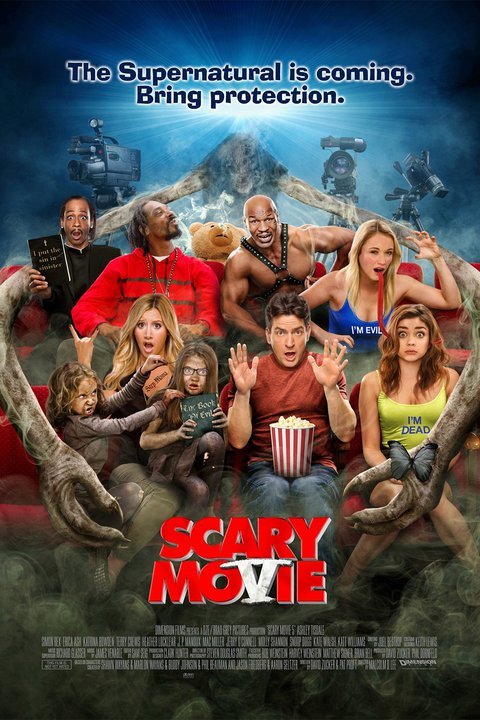
 The Parody phase is where films mimic the horror genre in a comical way, which eliminates the horror codes and conventions and would have typically have been there. Films such as Scary Movie (2000) which are very successful horror parodies that have continued for 13 years as the latest one (Scary Movie 5) has recently been released in 2013 and another (Scary Movie 6) is due to be released in 2016. The film has aspects of the codes and conventions of horror films such as jump-scares and they typically have the aspects of smoke and low- key lighting, however the film then continues to make a light hearted joke about the uneasy codes and conventions. Another film that creates the humorous aspects of horror films is the film 'Carry On Screaming'(1966) which presents a family that, aren't all that normal and a detective that is sent into the woods and disappears and is not seen again.The film makes multiple jokes about this in the way that similarly to the Scary Movie characters are to make comments that are seen as humorous due to their unexpected nature as there are large forms of danger that surrounds them.


4. The Deconstruction
 The Deconstruction phase is that the films which have taken the generic elements of the horror genre and amalgamated them into varying sub genres. Films such as Se7en (1995) and The Sixth Sense (1999) which both explore different types of genres in the within their narratives, for example Se7en involves elements of Film noir and the thriller genre into its story-line and editing. The Film noir element becomes apparent through its use of detectives in it's narrative. It also creates this aspect through the use of its low-key lighting which creates the same mysterious effect that it does in Film noirs. The thriller elements that are presented in the film Se7en is due to its story-line of the protagonist going after the antagonist in order to build tension and create a climax for the audience. The movie develops these codes and conventions to create a greater effect to work well with the codes and conventions of the horror genre that the movie also involves and uses effectively to create tension and keep the audience interested in the movie. The deconstruction overall involves taking aspects away from the core genre and adding aspects of other genres into the narrative and editing of the film.

Monday, 23 November 2015

MR JUDGE FEEDBACK

Hi Becky,

Please make your images bigger and more noticeable. Good work on Chinatown.


1.   STEREOTYPICAL REPRESENTATIONS OF THRILLER/HORROR GENRES/CHARACTERS

2.   TEXTUAL ANALYSIS OF OPENING OF A HORROR FILM – WOMEN IN BLACK/SCREAM etc.

Friday, 20 November 2015

Task 1 - Film Noir- Codes and Conventions

The term 'Film Noir' was created by Nino Frank, who was an Italian-born French film critic in 1946, the term itself means 'Black Film'. 


Film Noirs all have codes and conventions that are seen in almost all films in this genre. The most common convention that film noirs use is the narrative of the spider and fly. The spider and fly narrative is when the woman of the film draws the typically male detective in so that when the detective finds out she is part of the crime it is hard for him to do what he has to do for his job. An example of this although the film is a neo-noir, the spider and fly narrative still applies, is the film Chinatown (1974) the story-line is as follows "When Los Angeles private eye J.J. "Jake" Gittes (Jack Nicholson) is hired by Evelyn Mulwray to investigate her husband's activities, he believes it's a routine infidelity case. Jake's investigation soon becomes anything but routine when he meets the real Mrs. Mulwray (Faye Dunaway) and realizes he was hired by an imposter. Mr. Mulwray's sudden death sets Gittes on a tangled trail of corruption, deceit and sinister family secrets as Evelyn's father (John Huston) becomes a suspect in the case." -Google(Roger Ebert) There is typically an unspoken romance between the detective and the woman. The effect that this has on the audience is that they struggle to admit that she is the criminal, because of the romance between the detective and the woman. On the other hand the audience can also be effected in the way that they dread when the two characters create this unspoken romance, because they know that the woman will cause trouble and that the detective will have to turn her in so that he does his job. 


Another element of the effective use of lighting that they use within film noirs, the use of lighting to create the shadowing effect that most film noirs take advantage of.The low-key lighting creates the effect of mystery and helps build tension within the film. The effect that this has on the audience is that it makes the audience become intrigued as they want to know what is 'lurking in the shadows' it makes the audience continue watching the film, this is how the level of success is rated on films. The use of the lighting is also used to disguised the studio in the background. This was done because the small studios which were used to film the film noirs in would be shown in the film itself and would take away the separate universe that is created. These films were classed into B-list films, which would be shown in cinemas due to block booking. Block booking is where the cinema would buy A-list movies in 'blocks' of movies, this means that the B-list films that would be contained in the blocks would get profit from their movies being shown. The lighting in film noirs is described as "A feeling through a visual of low key lighting and story conventions". This supports the idea of the low key lighting being important to the story of the movie, it helps the studio get the message of mystery across to the audience. 

The iconography that is used in film noirs help create the moods of guilt and melancholy within the film.Iconography such as guns,cigarettes,trilby and overcoats. The iconography helps the audience identify the genre of the film. These types of iconography helps the studio present the atmosphere and emotions come across to the audience more clearly and helps the studio create what appeals the fans of that genre.The small details of things such as the trilby and and overcoat makes the movie come to life, it helps the audience fulfill their aim of watching movies which is to escape reality.The effects that the small details also make is that it makes people want to continue watching the movie,this is because they see the quality of the movie and are interested to see what happens as the small details portray the thought that it is a thought out movie that could have a strong and interesting story-line that they may not want to miss out on finding out about.  

Another convention that the genre uses effectively is the use of sound. The non- diegetic sound is a big aspect of film noir as they are typically created with background music throughout the film itself and not just the title or credits of a film. The music is typically created with strings and trumpets and normally creates a calming influence on the audience until something happens within the film and the music will become tense to help create the emotions that the film is trying to create for the audience to experience. The effect that this has is that it makes the film effective and makes the audience experience multiple feelings and helps them see different point of views from within the film. It helps them become engulfed in the film and helps the film fulfill the aim of making the audience feel what the characters feels as most of the time the story is told through the detectives point of view and the audience only knows as much as the detective.

Tuesday, 10 November 2015

Task 1 -Genre

Q. Where did genres come from?

A. In the 1900's studios and companies experimented with different types of genres, which lead to the population having a favourite genre which made more money because of its popularity then other genres. In the 1920's a lot of studios turning out specific types of genres, the genres that were popular were, Westerns and sci-Fi films which intrigues the audience a lot.

Q. How did the 'Golden Age' of Hollywood re-enforce genre?

A. There were five key studios in the Golden Age, which typically published films such as film noirs which have the spider and fly narrative, Other genres such as Western, War and crime/film noir genres these were popular because some genres were relevant to what was going on at the time.

Q.Which genre became popular in Hollywood?

A. Western films and sci-Fi films were very popular, watching about the past and about the present intrigued people of all ages. The success of these genres meant that studios began to cash count. Cash count is when studios turn out the popular genres (in this case Western or Sci-Fi) the reason they did this is because they knew people were going to watch them types of films as they were popular, so this meant that they were getting more money for the studio.

Q.Why do audiences like genre films?

A.People like genre films because some people prefer to watch a certain type of film, this may be horror, sci-Fi or even romance.The popular genres mean that studios still do cast count this is because they run off of capitalism. This means that studios create very similar films because of the genre that is popular at the time,this occurred as studios created films like James Bond and Fast and Furious around the same time this is because that genre of action was very popular. People's moods effect the type of genre that they want to watch so this is another reason audiences like genres,its because if they are sad then the audience would most likely want to watch a comedy or on the other hand if the audience was in a certain mood they may want to watch a horror film.

Monday, 9 November 2015

MR JUDGE FEEDBACK

Some excellent work is in evidence so far Rebecca so well done. You need to add the following to make sure you are on track for a level 4: 5. NO BLUE VELVET VIDEO EMBEDDING IN PLACE 7. NO VIDEO EMBEDDING FROM SE7EN TO ILLUSTRATE POINTS IN PLACE 8. NO work on GENRE from Mr Rutherford

Saturday, 7 November 2015

Task 1 - Researching into existing products Seven

Seven
Seven is a thriller/ horror film directed by David Fincher. The film is about a detective working his last case before retirement. He conducts this case with the newly transferred detective of a serial killer who is targeting people who he believes represents the seven deadly sins.

The opening scene of Seven (1995) is engulfing it throws the audience straight into the narrative. It opens with Morgan Freeman’s character (William Somerset) in his home which is pure white which represents the innocence of the man, it suggests to us that he doesn’t have a family and if he does then they live somewhere else as if there was there would be color and flowers that would indicate to the audience that he has a family. Then, what we assume to be an apartment due to its openness and one floor, is organised strictly. This is presented clearly through his bed being made perfectly, suggesting to us as the audience that he has had a military background, which is common for people in the police force, the organised items he has as he walks out of the door, which is presented through an over the shoulder, close up shot, this also suggests the military background. The organisation could suggest that he is good at his jobs as everything in his house is neat and exactly how he wants it so it may suggest he is good at picking out small details, this is supported by when he picks the tiny hair off of his jacket before he puts it on.
Another effective feature that David Fincher uses in the opening scene of Seven is the use of the diegetic sound, which we guess is amplified. The use of the sound of traffic and sirens that are going off in the city that the characters are presented in, suggests to the audience that the city poses danger on them and that the city is possibly ‘soaked in sin’ which in this case is what the killer believes. It gives the audience a glimpse at the narrative of the story which allows the audience to become even more involved in the story-line so soon into the film, which means that the film will be watched all the way through, this means that the film is successful. The effect that the traffic sounds such as tires screeching and sirens, have on the audience is to pursue a negative effect on the audience, a sense of possibility and unpredictability.  The unpredictability is presented later on in the film with the numerous about of murders and the method of the killings have no link, as it seems at first. The dialogue used that comes from detective Williams, suggests to us that he thinks differently to them around him, as he asks if the child saw it, when the child has been killed in one of the murders, this thought is supported throughout the opening scene as there are constant hints at his intelligence, from the chess board at the very beginning and his seemly odd questions.  

The use of pathetic fallacy within the opening scene is effective, this is because the film uses rain to reflect the mood and the relationship between the two detectives and the mood of the city. These things are both sadness and loss and it suggests a struggle, which could reflect the relationship. The use of pathetic fallacy helps the director make the audience share the emotions that the characters within the film have, it makes the scene more intense and creates more suspense for the audience which keeps them interested in the film. The sound of the rain within the scene makes the audience stay calm although still tense as they focus on the unstable relationship between the two detectives. The use of this device means that the director is easing the audience into the story-line, it suggests to the audience that the film will have loss and sadness within it. The use of the characters costumes suggests that the detectives were prepared for the rain, suggesting they are prepared for the crimes they are about to try and solve, in a way the rain is a catalyst for the numerous deaths as either after or before the audience is shown the murder scene there is a shot of the rain, it signifies to the audience that there is an environment of loss and sadness in the area.

The medium long shot that is used at the start of the opening scene when William is in his kitchen is used effectively too portray a message to the audience. The shot presents the costume of William which at the moment is an un-tucked shirt without a tie and suit trousers, this at first suggests to the audience that William is an average office worker, not necessarily a high qualified detective. The shot presents to the audience an average morning for an average person and not someone you would stereo-typically think of as a detective, this is because of his actions as he cleans out the coffee pot and his mug slowly and calmly, you would think that a detective would not have time to do this in the morning as stereo-typically we as the audience are presented with the fast pace detectives. The effect of that the audience believes that William is just a normal office worker means that the audience can briefly relate to him and can therefore start to make judgments of what type of person he is, they want to continue to watch to see if their thoughts were true and if they can relate to him anymore as a character. When the character turns around we are presented with his facial expression, which is relaxed and calm as he looks down at the buttons on his shirt, this again is not what you expect from the stereotypical detective, which means that the idea of him being a person with an average job is still apparent and people can still relate. The long shot presents to the audience his basic colored apartment and how he fits in perfectly with the basic colors of white and black due to his uniform, this suggests to us that the apartment is his and no one lives with him as the apartment and detective both reflect themselves. The shot has low key lighting which at this stage of the opening scene creates a calm and in a sense a moody emotions perhaps because the character doesn’t like his job or maybe the lighting is reflecting his age.

Overall the use of the codes and conventions to create the ‘neo-noir psychological thriller’ are very effective and put the audience on edge and makes them curious at what could happen within the rest of the film. It easily takes people away from their daily life with its new twists and turns in the narrative and the reoccurring enigmas throughout the film.


Sunday, 1 November 2015

Opening sequence conventions

The example I’m going to use to help demonstrate some conventions of opening sequences is the movie Scream (1996) this is because its opening sequence is very effective and fulfills many of the conventions.

An opening sequence needs to create an enigma the film Scream creates this through its use of mise en scene, the film uses lighting very effectively, this is because the house that the character is in is dark, and the lack of lighting throughout the house gives the audience an eerie feeling, it instantaneously makes us assume that she is in danger, the flicks of light, especially outside makes use on edge as we believe someone will be outside therefore us as an audience want to continue to watch the rest of the movie. This is represented in the image below, we anticipate the killer or at the moment the mystery man to be outside look back at the woman, as we expect him to want to get to here so we expect him to take the opportunity while she is by the door.
The opening scene also uses props to its advantage, before the phone rings for the 3rd time the woman lights the stove, the camera is zoomed in on this part of the scene. This suggests that the gas or the fire, this is because it is typically related to danger, therefore it builds up the tension that the lighting has already started to create. The colour scheme that is used is dark which creates a negative and dangerous effect to the film, it typically suggests death, which could suggest that the girl is going to die soon.

An important part of making sure that an opening scene is effective is that it is clearly an opening scene and not a trailer, this means that the film should go straight into the narrative and it should be clear to the audience so that they are intrigued and will continue to watch the film. The narrative becomes clear to the audience particularly fast, which makes the opening more effective. This is because of the dialogue that is exchanged between the killer and the woman, as it creates the intense atmosphere that the film intends to make, the voice of the characters are also very important in making the film effective and creating the tense environment that they want.

The use of diegetic and non-diegetic sound that is used throughout the opening scene of the film. The diegetic sounds such as the popcorn popping and the sizzling noise that it makes draws the audience’s attention to it and the pressure that is building up inside of it could be being used as foreshadowing the pressure that the woman is going to be under later on in the film, it could also suggest that there is a danger that will soon affect her as the popcorn could explode at any moment just like the killer cause come into the house. The diegetic sound of the dog barking as the woman locks the door also suggests danger, the dog could be barking at a trespasser, which suggests yet another danger to the young woman. The common occurrence of no background sound makes the audience focus on the phone call, to focus on the strange yet eerie voice down the phone, this helps to build up tension as the audience can’t focus on anything else in the film but the mans voice.  The non-diegetic sound that is created when the voice says “I want to know who I’m looking at” helps the film drawback any lost attention that it may have caused through the voice asking questions, it also makes clear that the woman’s emotions have changed, instead of being playful she has now become scared and on edge which makes the audience on edge as we now expect to see the person on the phone to be seen in a way that creates a possible jump scare for the audience.

The mind-map below presents to conventions of opening sequences.


Scream (1996) First five minuets.


Preliminary Task Evaluation

The story-line of the  preliminary task is about two associates who are passing information on about the character who is in the background, we allowed the audience to see both the associates however the audience doesn’t see their faces clearly until the end this create the atmosphere of mystery which was the effect we wanted to create. The audience sees the character who is being targeted going about her daily work, this helped us to portray the innocence of this character which makes them seem more like a victim which we is what we wanted.

The 180 degree rule which we didn’t break during the filming of the preliminary task, the 180 degree rule is when the camera can’t go over the ‘invisible line’, this invisible line is at 180 degrees this means that the camera can’t cross the line, it should only stage on one side of the line, this is because if the camera was to film both side of this line the audience would get confused about where things are positioned on screen as it would result in the characters or props on stage changing or switching positions in a scene that should be continuous and smooth. This means that the storyline may become more difficult to understand if the audience is focused on figuring out where the characters are on stage. If this happens the audience may not continue to watch the film or video that breaks the 180 degree rule as the audience may become unfocused, and entertained by the film, this means that the film or video hasn’t achieved its purpose. The 180 degree rule is more noticeable when both or all the characters on screen look similar or are dressed the same, this is because if the 180 degree rule is broken straight away then the audience hasn’t had time to adjust to the who the characters are therefore the audience may become confused on who the protagonist is or the villain.
The match on action shot or shot reverse shot, is when the camera shows someone passing something to another person, the camera is zoomed to a close up of the character’s hands both on the object and then the camera is zoomed out to show the person taking the object out of the other person’s hands. The shots are connected with a cut, this creates the impression of continuity in the scene. The effect of this shot is that it creates tension and allows the audience to focus on the typically important object, such as an important document or even a weapon. The shot can also be portrayed through a character opening a door, this would be created as the first shot would typically be a close up of the character’s hand on the door handle as they begin to open the door. The cut will then connect the second shot of the person entering the room, the shot would be taken from inside the room and show the character walking inside and the door closing behind them. When the shot is used in this way the effective it has on the audience is that it presents a continuous affect that makes the cut discrete it makes the scene flow which means that the audience will continue to be intrigued with the scene.
The Eye Line match shot is used carefully with the shot reverse shot. The Eye Line match shot means that the gaze of the characters in one shot have to line up and be on the same level. For instance if one character is taller than the other the taller character would need to look down and the smaller character would be looking up, so that they are looking at the same level in the shot. 
A Shot Reverse Shot is here one character is where one character is shown looking at another character and then the second character is shown looking back at the first character, because the characters are looking in opposite directions so the audience presumes that they are looking at each other. The shot is considered as a ‘classical’ Hollywood style of continuity editing.
In our Preliminary task, used the 180 degree rule when the two characters interacted as the character remains on one side of the two characters, and the camera doesn’t cross this line, this means that the audience doesn’t get confused while watching the short film, the shot below presents what part we had to be careful not to break the 180 degree rule (the first image is the closest we got to the 180 degree line) We incorporated the eye line match in this shot too, the two characters’ eyes are lined up on the screen. To line up the two characters’ eyes we angled the camera so that the character that is further away and the character who we have taken the over the shoulder shot from, both their eyes line up. In this scene we also used the shot reverse shot, as the two characters look at each other and the camera presents them clearly looking at each other, the use of this shot creates tension to the audience as they are able to see the facial expressions of both characters (both of these shots are shown through image 1 and image 2). Within the Preliminary task (third image) we used a match on action shot, we incorporated this shot as the characters are passing an ‘important’ document. This scene creates tension as the audience doesn’t know what the document contains and they want to carry on watching as it is presented through this shot that the document is an important part of the story-line
The filmmaking process went smoothly, we used the storyboard to make sure we got the shots that we needed and that the storyline itself makes sense and is as clear as we can make it for the audience. Filming within the college was simple, this is because we had set it in a business like environment which meant that the actors we had were already in appropriate clothes. The shots we planned in the storyboard were very similar we had added in a couple of shots and changed some of the order of them so that the film would make more sense to the audience. We had a slight issue with the sound that people made within the college, however, we were able to edit so that the audience couldn’t hear it. When we used Adobe Premiere I learnt how to cut clips so that they are made shorter which means that the clips we had filmed fit smoothly together. I also learnt how to import music and sounds so that the audio of the film is enhanced or more appealing to the audience. I also learnt how to make the transitions make the film smoother, it also means that I am more able to create titles that fit well with the genre of the film.  
The preliminary Task


.